How to Structure a Presentation Website That Generates Quote Requests
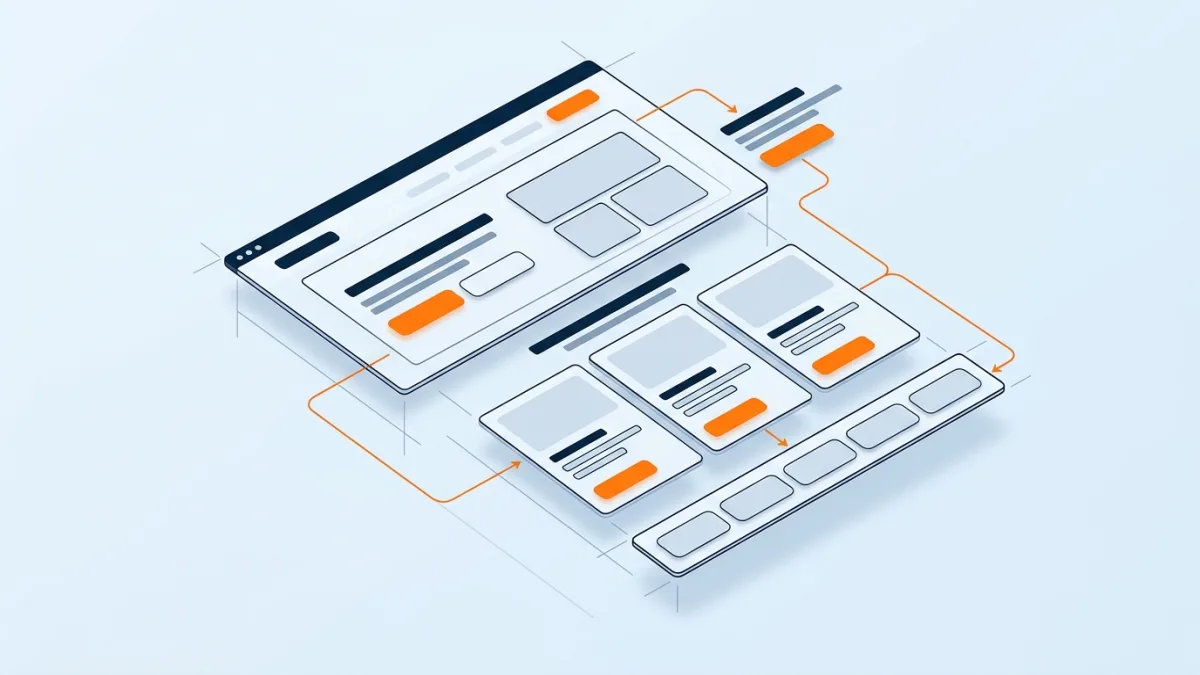
Most business websites lose prospects not because the company behind them lacks expertise, but because visitors cannot tell within the first 10 seconds what problem you solve, who you work with, what the ballpark investment looks like, and what step to take next. Effective web design pairs clean visual craft with a structured decision path built for conversions.
1. Why the classic “online brochure” model underperforms
Many companies structure their website around internal statements (“We are a passionate team founded in X”) instead of answering the buyer’s immediate questions. Every prospective B2B or service buyer lands on your page with three urgent questions:
- Does this company solve my exact problem?
- Have they delivered similar results for businesses like mine?
- Does it fit my budget and timeline, and how fast can I get a quote?
2. Recommended 7-section architecture for a high-converting service page
The order of sections follows how real buyers evaluate vendors:
- Outcome-led hero: Clear H1 (service + value + target audience), concise summary, and a prominent primary CTA.
- Problem & tangible outcomes: Practical benefits in plain language rather than abstract buzzwords.
- Transparent packages & indicative pricing: Showing structured tiers (“starting from €X”) filters out mismatched inquiries and builds immediate trust.
- Real portfolio proof: Delivered projects, real screenshots, project context, and measurable results.
- Clear 3–4 step workflow: Shows prospects exactly what happens after they submit an inquiry (discovery, proposal, build, launch).
- Focused FAQ section: Resolves common objections on timelines, payment milestones, and ongoing support.
- Streamlined form or interactive configurator: Positioned at the decision point with minimal required fields and clear response-time expectations.
| Element | Generic Brochure Website | Conversion-Focused Website |
|---|---|---|
| Hero message | Abstract tagline (“Complete solutions for you”) | Specific service, audience, and clear CTA |
| Pricing clarity | Missing entirely (“Price on request”) | Indicative tiers or interactive scope estimator |
| Proof | Generic claims without examples | Real projects, screenshots, and metrics |
| Lead capture | Plain “Name / Email / Message” box | Contextual form linked to the selected package |
3. Why interactive quote forms and estimators convert better
When visitors can choose a package or toggle required features directly on the page, two things happen at once:
- For the buyer: uncertainty drops because they immediately see what each investment tier covers.
- For your sales team: every incoming lead arrives pre-qualified with the selected package and scope, saving hours on discovery calls.
4. Trust signals and mobile ergonomics
Before launching into production, double-check these fundamentals:
- Company identification details, business hours, and GDPR / privacy notices are easy to access in the footer and alongside forms.
- Every CTA leads to a working action with zero placeholder links or unfinished pages.
- Form submissions display clear confirmation feedback and trigger instant internal notifications.
Frequently asked questions
Should I display pricing on my business website?
Yes — at least indicative starting prices or structured tiers. Transparency builds buyer trust and pre-qualifies incoming inquiries.
How many fields should a quote request form have?
Ideally 3 to 5 essential fields (name, email/phone, selected package, and a brief note). Every unnecessary field lowers mobile completion rates.
Is a one-page website or dedicated service pages better?
For both organic SEO and Google Ads, dedicated service pages perform significantly better because each page targets a specific search intent and dedicated FAQ.
How often should portfolio projects and site copy be updated?
Aim to add fresh projects and helpful articles at least quarterly to signal active delivery to both buyers and search engines.
Related articles
 SEO & AI Search
How AI Search Influences Your Website Visibility on Google
AI-generated search answers are changing how buyers discover businesses and compare providers. Learn how Google AI Overviews work, which signals conversational engines rely on, and how to structure your site to earn citations.
Read article Web Performance
Website Speed and Core Web Vitals: Why They Matter for Conversions
Every extra second of mobile load time increases bounce rates and drives up Google Ads acquisition costs. Learn what Core Web Vitals (LCP, INP, CLS) actually measure and which technical optimizations push PageSpeed toward 95–100.
Read article